Scope Technology & Manufacturing
Beyond “No Data Centers”: Finding Common Ground Between Growth and Protection
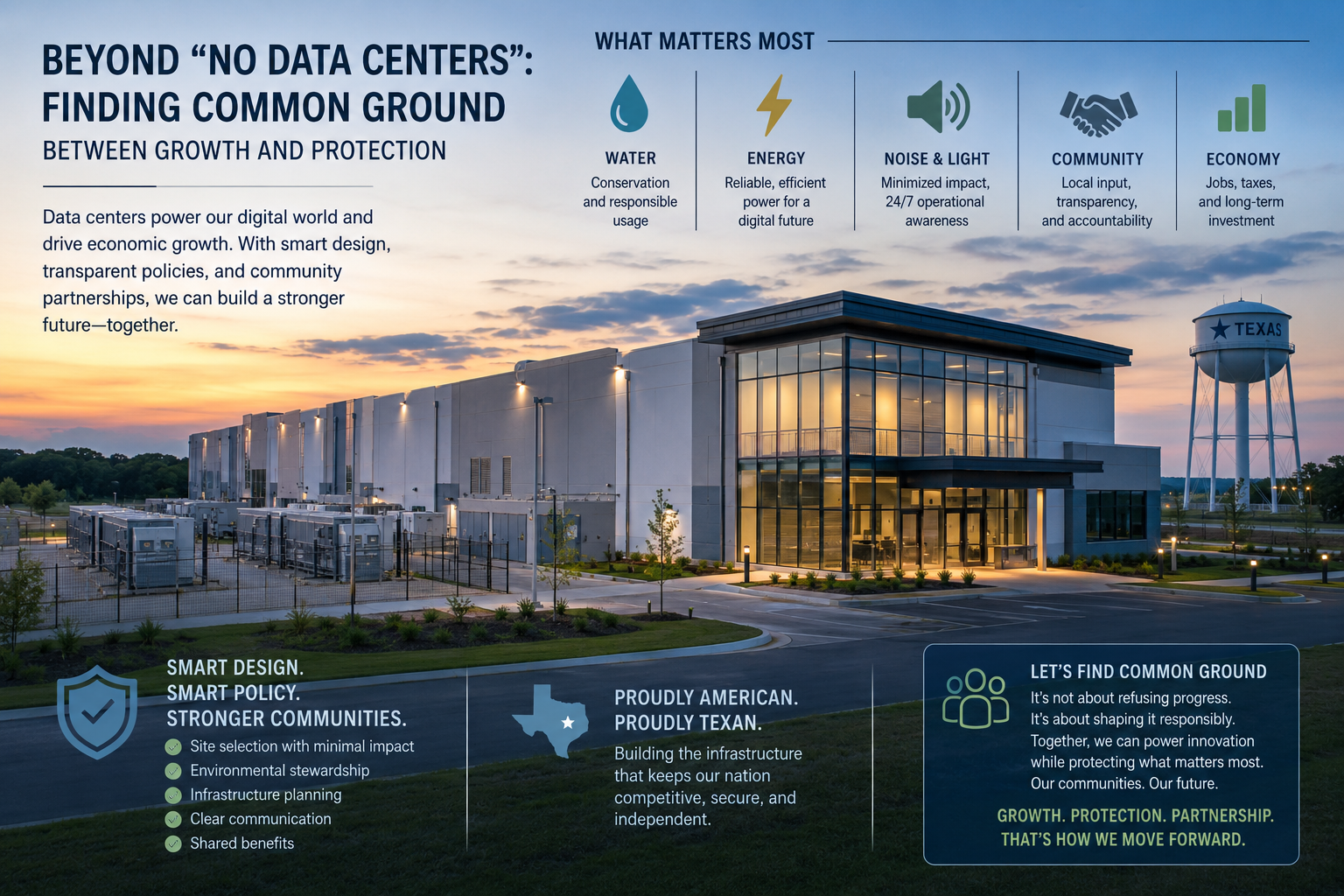
The internet is in rapid fire mode. Texas Coalition against Data Centers, Texans United Against Data centers, Save Hill County, etc., the list goes on and on. Many are sites I belong to…, not because I am against AI, or advanced compute technology. In fact, I like technology, it helps me earn a living. Equally, I do live and work in rural Texas. Does this make me think about the five “w” rule, yes! I want to know Who, What Where, When, and Why.
Beyond “No Data Centers”: Finding Common Ground Between Growth and Protection
My name is Chris Koch. I live in Hill County, Texas. I am a business leader/developer of ScopeTechX. I pay taxes and support the economy. I am for Smart Design, Smart Policy, and progressive technology. I am proudly American/Texan.
The internet is in rapid fire mode. Texas Coalition against Data Centers, Texans United Against Data centers, Save Hill County, etc., the list goes on and on. Many are sites I belong to..., not because I am against AI, or advanced compute technology. In fact, I like technology, it helps me earn a living. Equally, I do live and work in rural Texas. Does this make me think about the five “w” rule, yes! I want to know Who, What Where, When, and Why.
In many rural communities across America, a growing narrative has emerged: “No Data Centers.” The message is understandable. Residents see thousands of acres being acquired by well-hidden LLC’s buying property without knowledge beyond its intended use. They voice concerns about water use, size, electric demand, noise, lighting, and taxes. Changes to their quality of life, and they naturally ask whether the benefits outweigh the costs. At the same time, technology continues to advance, artificial intelligence is expanding rapidly, and data infrastructure has become as essential to the modern economy as highways, railroads, pipelines, and telecommunications networks were in previous generations. We ALL USE IT! What people do not understand is why it is necessary to build so many. It is a race..., plain and simple. He who advances first controls their own Nation. The biggest race is between the USA and China. If we lose, we become dependent on other nations for our very survival today and in the future.
History offers an important lesson.
During the energy crises of the 1970s, the United States experienced firsthand what happens when a nation becomes heavily dependent on resources controlled elsewhere. America was hooked on Middle Eastern oil. Energy shortages happened, supply disruptions, economic uncertainty, inflationary pressures, and political tensions affected households, businesses, and government alike. You had ration days and days that you could only get fuel depending on what number your license plate ended with odd, or even. The lesson was not merely about oil. The lesson was about strategic dependence. If a nation lacks control over a resource that becomes essential to modern life, it often becomes vulnerable to those who control it.
The challenge is that the debate has increasingly become framed as a choice between two extremes: either unrestricted development or complete opposition. In reality, neither position serves communities well.
Politics Is Part of the Equation—But Not the Entire Answer
A lot of the influencers on Facebook (some of the sites mentioned) and X, YouTube and others believe the narrative to its core. They are often against anything. As of yesterday, I saw a post that was reposted thousands of times over. It was a long letter of warning to the Governor of Texas that come November he better watch out. That was written by a person that I have met and seen a dozen times over at commissioner courts, town halls, even at the State Capitol in Austin. This person threatened that a certain political party will switch if a ban is not fully implemented. So, let us think about that with some facts.
1. Both major political parties have played roles in shaping economic development policies that encourage large infrastructure projects, including data centers. California is/was the epicenter of global tech for decades. Which party runs that state?
2. All the big tech guys known today and most major Wall Street people voted Democrat for years and got behind almost every social issue in the last decade. #MeToo-2017, #BlackLivesMatter-2020, #FridaysForFuture/#ClimateStrike-2018, #StopAsianHate-2021, #NeverAgain/#MarchForOurLives-2018, and we cannot forget the infamous #StandWithUkraine-2022, and #FreeFreePalestine/#StandWithIsrael-2023 to present.
Now because Tech is moving into Texas and other places normal people including myself are questioning the intent, wanting details and have legitimate questions and fear. So now we have the narrative #StopDataCenterTexas and similar movements across the nation.
3. All candidates from across the political spectrum routinely accept support from political action committees (PACs), industry groups, labor organizations, energy companies, big pharma, technology interests, Wall Street giants and various advocacy organizations. It does not mean they are crooked, or for or against something when it is first introduced. When money is involved, everybody gets excited.
Reality is more nuanced than many public narratives suggest. Most PACs are not monolithic organizations advancing a single agenda. Many are supported by a broad mix of stakeholders with differing priorities, including technology companies, infrastructure firms, labor groups, investors, property owners, and community advocates. Political influence exists throughout the system, but it is not exclusive to one party, one industry, or one ideology.
For that reason, assigning blame solely to Republicans, Democrats, developers, environmental groups, or local county officials oversimplifies a much more complex issue. Communities deserve transparency regarding political influence, campaign contributions, and development incentives, but they also deserve practical solutions rather than partisan talking points.
The Legitimate Concerns of Rural Landowners
Rural landowners are often the first to experience the impacts of large-scale development. Their concerns deserve sincere consideration and should not be dismissed as anti- technology or anti-business. Questions commonly raised include:
• Protection of groundwater resources. Environmental risks. • Increased demand for the local electric infrastructure. • Emergency response capabilities. • Noise and vibration impacts. Waste heat and Light pollution. • Quality of life • Effects on property values. • Traffic and road degradation. • Ranching and Wildlife concerns. • Long-term commitments made by developers.
These concerns are reasonable because the consequences are local and permanent. Technology or any other company can pull up and relocate in the future as advancements are made; the community remains.
Strong property rights should include not only the right to sell land for development, but also the right of neighboring property owners to have meaningful protections against avoidable impacts.
The Legitimate Need for Technology Infrastructure
At the same time, modern technology requires physical infrastructure. Every cloud service, online transaction, emergency communication system, educational platform, medical database, and AI application depends on digital infrastructure operators somewhere. You use it now. Your Amazon order, PayPal, Venmo, HEB orders, DoorDash, you name it and have the app on a phone, tablet or computer..., your using AI, Period!
Rejecting all future data center development is unlikely to stop technological growth. More likely, it simply shifts projects to other communities, states, or countries..., often with weaker environmental standards and less public oversight.
The question should therefore not be whether technology progresses, but how it progresses. If communities can establish clear expectations before development occurs, then economic growth and community protection become compatible rather than competing objectives. This keeps America secure, resilient, and prosperous.
A Better Path: Smarter Design
Technology developers should recognize that public opposition often stems from design choices rather than the existence of the project itself. At ScopeTechX, we have focused our efforts on advancing what we call Smart Design Infrastructure..., an engineering philosophy centered on reducing environmental impact while improving operational efficiency and long-term economic performance.
Rather than treating community concerns as obstacles, Smart Design treats them as engineering challenges to be solved. Better design can reduce many of the concerns driving the “No Data Center” movement:
ScopeTechX's (Smart Design) framework emphasizes true closed-loop thermal capture systems with redundant process exchange points that continuously recycle and reuse resources internally. Instead of viewing water as a constantly consumed input, these systems are designed to maximize recirculation, minimize withdrawals, and reduce dependency on external sources wherever possible.
Similarly, waste heat is not simply rejected into the environment. It is captured, transferred, repurposed, and integrated into broader energy recovery systems. This approach reduces waste while increasing overall operational resilience. Turning Waste into Value.
One of the largest untapped opportunities in today’s modern infrastructure is the utilization of waste heat. By capturing thermal energy that would otherwise be lost, facilities can generate usable internal power for process operations, offset electrical demand, support auxiliary systems, or potentially provide transferable energy at grid intersection points where practical and economically viable.
The concept is straightforward: infrastructure should not only consume energy..., but it should also recover, reuse, and maximize it. Once the natural gas turbine is on, the fuel is already paid for. Once the center is online our/my goal is to keep reusing the same energy repeatedly for more efficient internal series of processes until all of it is exhausted.
Using Blended Topography and Minimal Footprint Development.
ScopeTechX, (Smart Design) seeks to reduce that impact through blended topography, thoughtful site integration, reduced visual profiles, strategic earthwork utilization, sound attenuation, and land-use planning that works with the existing environment rather than against it. The objective is not simply to hide infrastructure but to design facilities that are less disruptive to surrounding communities while occupying the smallest viable footprint necessary for operation. When done correctly, this approach can reduce visual intrusion, noise propagation, thermal impacts, and overall environmental disturbance. When developers invest in minimizing impacts, community opposition often decreases because residents can see tangible efforts to respect local concerns. Conversely, investor returns increase due to the proper use of energy throughout the process.
A Better Path: Smarter Policy
Good public policy should neither prohibit development nor provide unrestricted approval. Instead, policymakers should establish predictable standards that protect communities while allowing investment.
Examples include:
• Mandatory Environmental Monitoring • Groundwater monitoring. • Air quality reporting. • Noise compliance testing. • Community Impact Agreements • Local infrastructure improvements. • Road maintenance contributions. • Emergency services support. • Transparency Requirements • Public disclosure of water use. • Energy consumption reporting. • Environmental mitigation plans. • Property Owner Protections • Clear setback requirements. • Buffer zones. • Independent complaint resolution mechanisms. • Performance-Based Standards
Regulate outcomes rather than technologies allows for innovation while maintaining accountability. Such policies would create certainty for both developers and communities. Moving Beyond “Yes” or “No”
The most productive conversations rarely begin with absolute positions. “Build whatever you want” ignores legitimate community concerns. “Build nothing ever” ignores the realities of economic and technological development. The real opportunity lies in designing projects and policies that acknowledge both truths:
• Rural communities deserve protection. • Property owners deserve rights. • Technology continues to evolve. • Economic development remains important. • Environmental stewardship matters. • Public trust must be earned.
Communities should not be forced to choose between prosperity and preservation. Through better engineering, transparent governance, responsible corporate behavior, and balanced public policy, it is possible to create a framework where innovation and rural quality of life coexist.
The goal should not be to win an argument between technology, politics, and communities. The goal should be creating conditions where both can succeed together. That is the compromise most Americans want..., and the foundation upon which sustainable progress is built.